
News
We will constantly surpass ourselves to create value for clients, strive for winning the long term trust from clients with better products and services!
Is MLCC a Better Choice? Evaluation of Replacing Film Capacitors with Multilayer Ceramic Capacitors in Wireless Chargers
The following article is from Murata China Author Murata
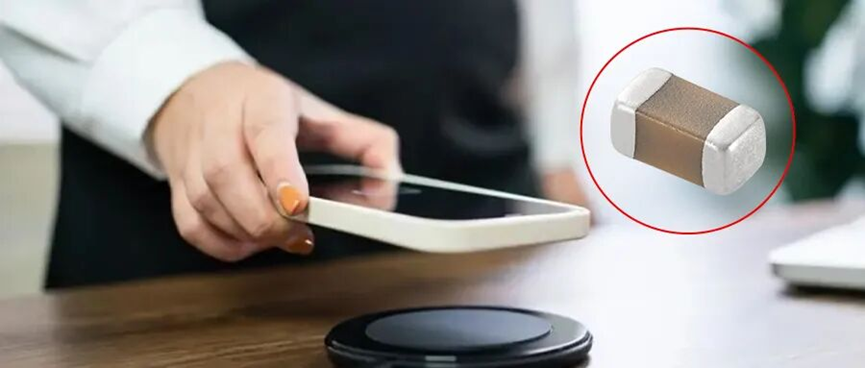
In wireless chargers, film capacitors are sometimes used in the resonant circuit. MLCCs are more suitable for miniaturization and can help reduce mounting area. Additionally, MLCCs generally offer advantages in terms of device surface temperature control and power conversion efficiency. Here, we present an evaluation conducted by Murata on replacing film capacitors with multilayer ceramic capacitors (MLCCs).
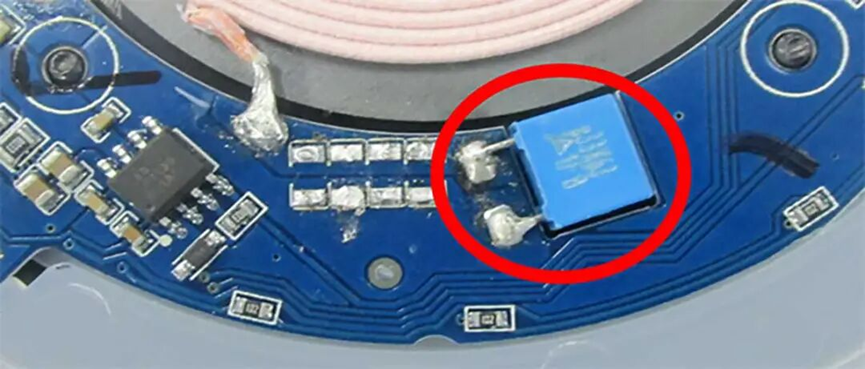
Evaluation Subject
We conducted a replacement evaluation using a commercially available wireless charger. In the photo below, the red circles indicate the film capacitors installed as resonant capacitors in the original design.
Replacement Proposal
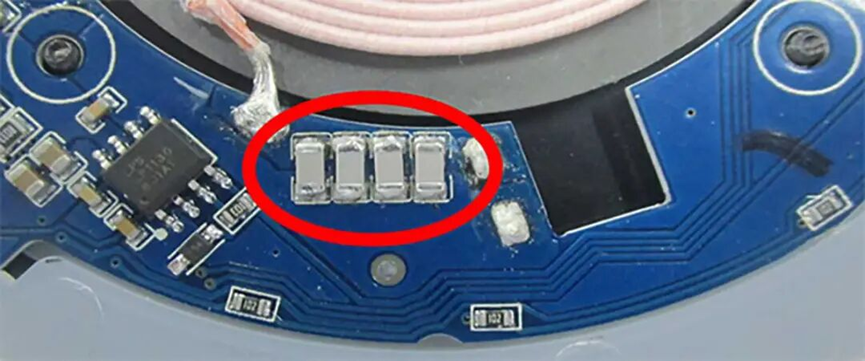
In the original design (shown above), the film capacitor specifications are 7.3 × 6.5mm, 0.33μF, 63V. The Murata replacement proposal is shown in the image below. The replacement product is GRM3195C2A104JA01 (1206, C0G, 0.1μF, 100V).
Proposal Evaluation
To evaluate the results after replacing the film capacitor, we verified the following characteristics (evaluation items) during charging before and after the capacitor replacement:
1. Capacitor surface temperature rise
2. Power conversion efficiency
Measuring Capacitor Surface Temperature
The conditions for measuring the capacitor surface temperature were set as follows:
· Operating Environment: When using the wireless charger
· Measurement Environment: Placing the wireless charger inside a wind shield for measurement
· Measurement Equipment: Infrared thermal camera
· Room Temperature During Measurement:
o When measuring the film capacitor: 26.0°C
o When measuring the MLCC: 24.5°C
o
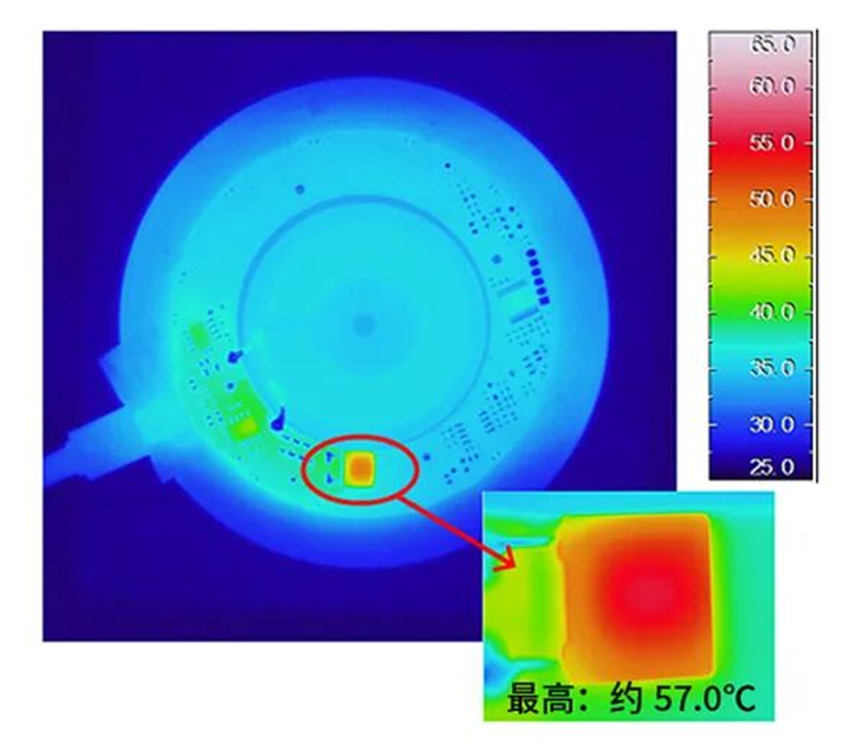
Film Capacitor: 7.3×6.5mm, 0.33μF, 63V
Peak Temperature: Approximately 57.0°C
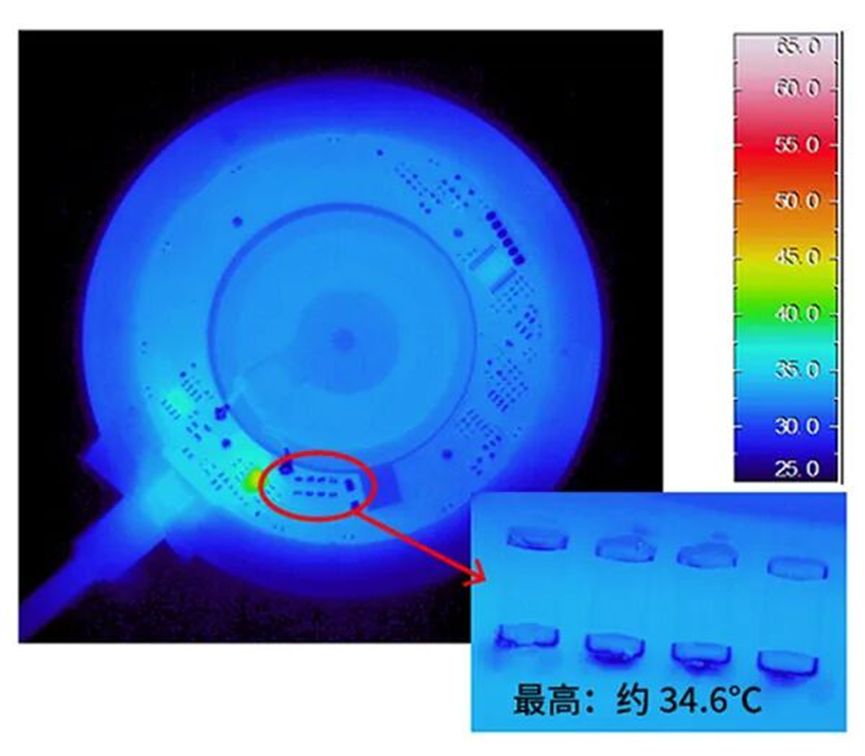
MLCC: GRM3195C2A104JA01 (1206, C0G, 0.1μF, 100V) × 4 pieces
Peak Temperature: Approximately 34.6°C
This measurement confirmed a difference in surface temperature rise exceeding 20°C between the film capacitor and the MLCC.
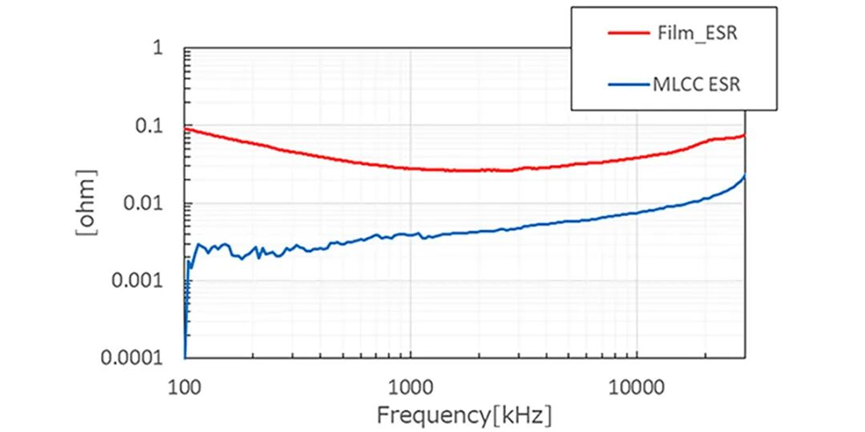
Furthermore, the ESR (Equivalent Series Resistance) of the MLCC is lower than that of the film capacitor, resulting in better temperature rise control.
ESR Curve Comparison: Film Capacitor vs. MLCC
Power Conversion Efficiency
Using the capacitors mentioned above, we evaluated the power conversion efficiency during charging. This evaluation confirmed that the power conversion efficiency of the MLCC is more than 2% better than that of the film capacitor.

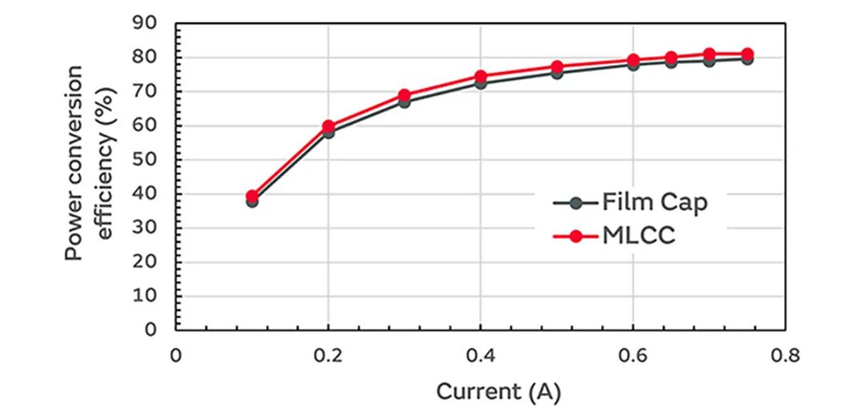
Power Conversion Efficiency Comparison: Film Capacitor vs. MLCC
Summary
We replaced the film capacitors in the original wireless charger design with MLCCs and verified the characteristics of capacitor surface temperature rise and power conversion efficiency during charging. The results show that the MLCC solution offers prominent advantages in the following three aspects:
· Capacitor Surface Temperature Rise: The MLCC's ESR (Equivalent Series Resistance) was confirmed to be lower than that of the film capacitor, resulting in a difference in surface temperature rise exceeding 20°C.
·
· Power Conversion Efficiency: The MLCC's power conversion efficiency was confirmed to be more than 2% better than that of the film capacitor.
· Space Advantage: In a direct comparison between an MLCC and a film capacitor, the MLCC is more suitable for miniaturization and can help reduce mounting area.
The alternative solution uses four MLCCs from Murata Manufacturing Co., Ltd.: GRM3195C2A104JA01 (1206, C0G, 0.1μF, 100V).
About E-Mantech
SHENZHEN E-MANTECH CO., LIMITED was established in 2014 with a registered capital of 10 million RMB.
Its predecessor was Shenzhen Hainengda Technology Development Co., Ltd., founded in 2005.
The company is committed to becoming the preferred trading platform for electronic components in the Chinese electronics industry.
Currently, it is a first level agent for Murata in Japan, an AVX agent, a Philips power agent, a KEC agent, a Prisemi agent for Xindao, a BPS agent for Jingfeng Mingyuan, a GPI agent for New Century,
a TELINK agent for Tailing, an SGX agent, and a WE smart agent. Our products cover fields such as communication, automotive, industrial control, medical, home appliances, lighting, power supply,
security, new energy, and consumer electronics; Our business covers regions such as Hong Kong, South China, East China, North China, Central China, and Southwest China.
Contact phone number: 0755-88352448 88352450
Official website: www.himantech.com
Official account: E-Mantech
QQ:800004227
Email: service@hi-mantech.com
Address: Room 1601, Block A, Coolpad Building, Intersection of Baoshen Road and Keyuan North Road, Xili Street, Nanshan District, Shenzhen
