News
We will constantly surpass ourselves to create value for clients, strive for winning the long term trust from clients with better products and services!
Murata Interview | Equipping Solar Power Generation with an AI
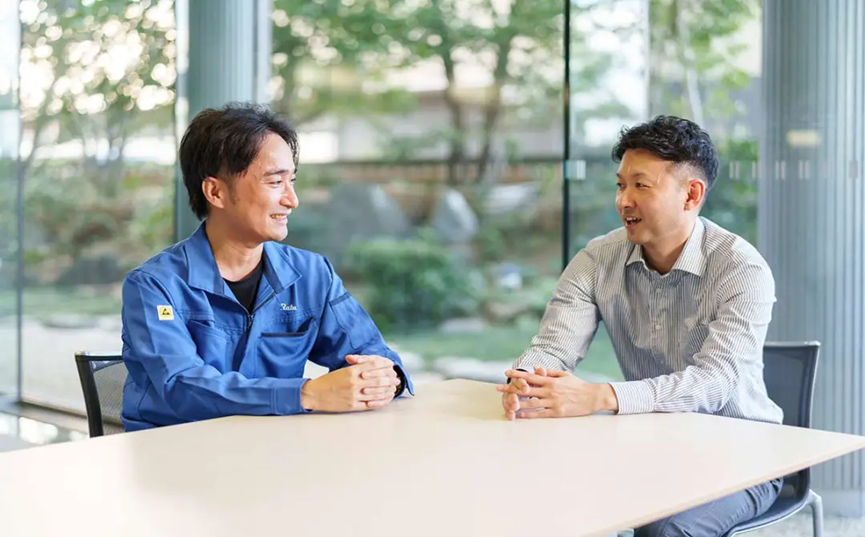
The revised Energy Basic Plan for 2025 sets a target for renewable energy to constitute 40% to 50% of the energy supply and demand by 2040. To contribute to this goal, Murata Manufacturing Co., Ltd. has developed "efinnos," an integrated renewable energy control solution utilizing AI. Since 2021, it has been piloted in a project to fully convert five Murata company factory facilities to renewable energy, continuously accumulating operational experience and results. To learn more about the technical features and future prospects of efinnos, we interviewed Yoshinori Nodo and Takashi Mukaï (pictured below), responsible for Murata's energy business.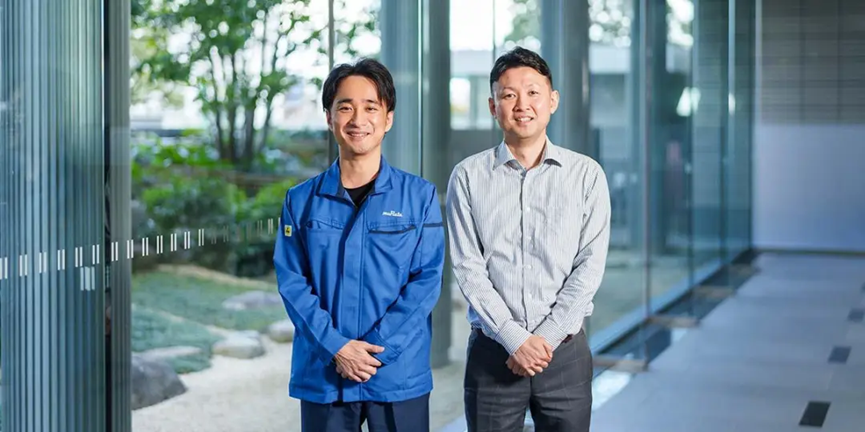
What is Murata's "efinnos"?
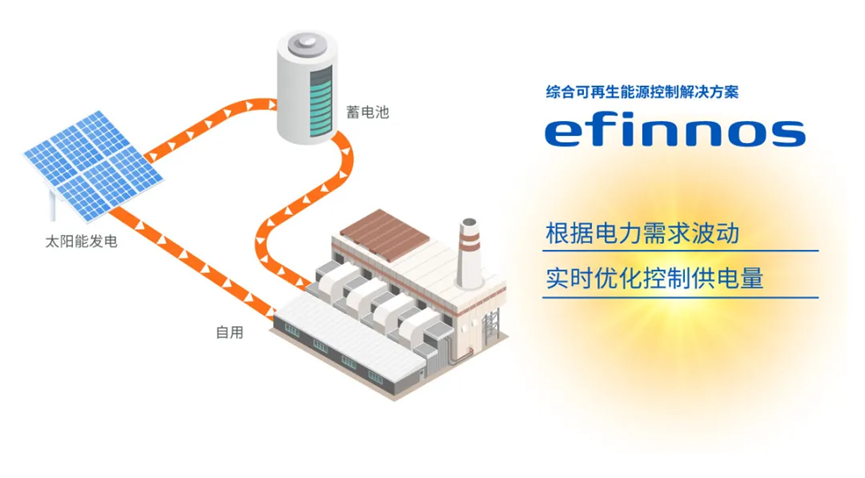
Efinnos is an energy management solution developed by Murata to address challenges in solar power generation. It is a mechanism that combines solar power generation equipment with storage batteries to achieve a stable energy supply (see diagram below). Efinnos can optimize and control power supply according to fluctuations in electricity demand. Initially deployed at several Murata factories, it is understood that multiple other companies have now also introduced the system.
What factors prompted Murata to develop efinnos?
Firstly, solar power generation is significantly affected by weather conditions. For example, if it snows, power generation can drop to almost zero. Even on sunny days, the presence of light clouds can reduce output.
Furthermore, in actual factory operations, electricity consumption varies greatly depending on the work content. This leads to supply-demand mismatches: days with high consumption might coincide with low generation, and vice versa.
Efinnos was developed to solve this problem.
It is worth noting that Murata Manufacturing is a member of RE100. RE100 aims to source 100% of the electricity used in operations from renewables. Therefore, we want to fully utilize the electricity generated by our own solar power equipment without waste.
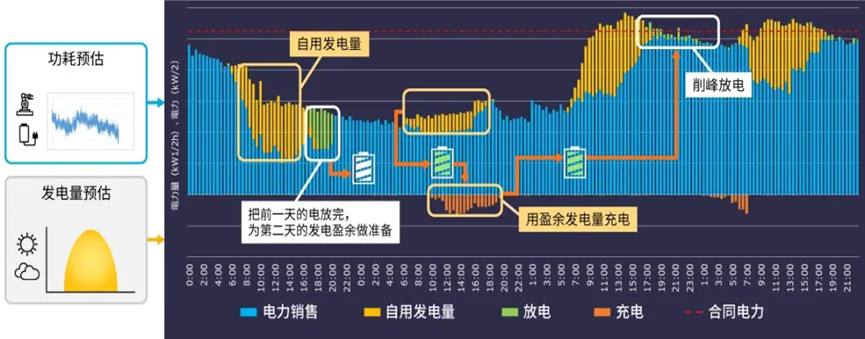
Another goal in developing the efinnos solution was to introduce AI into the EMS (Energy Management System) to eliminate supply-demand mismatches and achieve ideal control. Murata believes this solution enables detailed power control, predicated on the premise of self-consumption rather than selling power to the grid. Efinnos determines when to store and when to discharge electricity by considering generation and consumption levels, which change with weather and other conditions. As a result, by efficiently storing surplus electricity in batteries instead of wasting it, solar power generation can be maximized. This comprehensive capability is a key feature of efinnos.
What are the operational effects of efinnos?
It is reported that, besides five Murata factories, several other companies have already introduced efinnos. According to Nodo, the main reasons for the positive expectations and evaluations are the system's ability to provide both economic and environmental value simultaneously.
Firstly, from an economic perspective, under power generation optimized for the FIT (Feed-in Tariff) scheme, all electricity is sold, so control over charging and discharging like efinnos provides is unnecessary. However, with declining purchase prices and significant rises in electricity rates, an increasing number of companies are now considering "reducing electricity costs" through self-consumption rather than selling power.
Moreover, when electricity is sold via FIT, the environmental value belongs to the state, not the company. Murata Manufacturing also used to sell power, but since developing efinnos, we have chosen to self-consume all electricity generated by our solar panels. By comprehensively controlling generation, storage, and consumption, Murata Manufacturing can also claim the environmental value, thereby contributing to TCFD (Task Force on Climate-related Financial Disclosures) reporting.
Additionally, by drawing attention to efinnos as a new technology, we believe we can demonstrate a corporate image that actively addresses environmental issues.
What is the main operational mechanism of efinnos?
The mechanism by which efinnos achieves electricity cost reduction is its "peak shaving function" (see diagram below), which uses AI to forecast peaks in power consumption to level the electricity load. This helps control contracted power capacity, thereby reducing annual electricity costs. This is also an effect anticipated by companies introducing this solution.
Many companies prioritize economic benefits, so before introduction, we conduct multifaceted simulations and explain the potential effects. Furthermore, even after efinnos is introduced, we continue to maintain regular contact with companies to meet new needs.
Achievements through Challenge!
Murata began developing efinnos in 2019, a pioneering effort without precedent. What changes have occurred within the company from then until now?
Nodo explains: "I personally became aware of these issues while originally handling energy-related business, so I wanted to create something that could yield results quickly. As funding was required, there were some internal doubts about whether this was truly feasible, but we believed 'this technology will surely be needed in the near future.' As part of the company culture, which encourages tackling new challenges early on, management was also very supportive."
At Murata Manufacturing's Kanazu Plant, introduction progressed smoothly, and operational results were achieved earlier than expected. The factory is equipped with panels that allow real-time monitoring of power generation and battery status. By engaging with renewables daily, the environmental awareness of relevant personnel seems to have been positively influenced.
Since efinnos gained recognition internally, new members have increasingly joined the project, including colleagues with solar power generation at their sites and those interested in storage batteries. Currently, efinnos is managed by a team of about 10 people. During internal exhibitions, more people are asking questions about energy saving and renewables, giving a sense that environmental awareness is growing.
What difficulties were encountered during development?
According to Mukaï: From a technical perspective, due to its scale, conducting simulation tests was not straightforward. The products we usually make are smaller, allowing experiments in limited spaces and data collection before trial runs. However, for efinnos, trial runs were impossible before deployment in an actual factory. Even after numerous simulations, upon actual operation, issues like equipment response and communication status differing from expectations arose, requiring on-site adjustments. This kind of responsive troubleshooting was challenging.
It is reported that when starting up the equipment at the Kanazu Plant, the project leader went on-site. However, due to the impact of COVID-19 in 2021, frequent travel was impossible, so he had to stay alone for an extended period. During coordination with the local power company, to prove the system would not adversely affect the grid, quite detailed explanations were required, making adjustments more difficult than imagined. As a renewable energy self-consumption system of this scale cooperating with storage batteries had no precedent, adjustments took a long time, resulting in the stay in Fukui extending from the planned one month to four. However, the detailed adjustments and explanations conducted then are now fully utilized when introducing efinnos elsewhere.
The Future of efinnos: Expanding the Scope of Use
Currently, the social value of efinnos is gaining attention, but for continued contribution to solving environmental issues, business benefits are essential.
Currently, initial costs can still be a potential barrier. Therefore, we aim to control costs by connecting storage batteries with appropriate specifications for each use case and increase benefits for introducers by further improving control accuracy, thereby enhancing the system's value.
To this end, we also hope more people will learn about efinnos, increasing partners to advance renewable energy utilization with us. We aim to create opportunities to visit and experience efinnos and sites using renewable energy. The Kanazu Plant sometimes hosts visits from local children and students as part of environmental education. Ideally, there would be a place where more people, including local residents and businesses, could freely visit.
Increased solar power generation may strain the grid due to supply instability. Power companies need to adjust sales volumes and maintain equipment to balance supply and demand. We believe that through efinnos' control, storage batteries can be used to adjust power supply and demand balance, potentially playing a significant role in stabilizing power supply.
Furthermore, in the near future, it will be necessary to expand the scope of efinnos to enable control over energy sources beyond solar power. Particularly promising is green hydrogen produced via water electrolysis using renewable energy. Generated electricity could be stored not only in batteries but also converted and stored as hydrogen, further expanding energy utilization possibilities. Although technical issues exist, such as improving AI monitoring accuracy, we hope to prepare early and start working on them promptly to clarify challenges.
Previously, it was thought that electricity demand would not grow significantly due to population decline and progress in energy conservation. However, due to factors like the rapid expansion of AI applications and increased data center demand, electricity demand is projected to increase. We strive to contribute to the stability of power generation and utilization systems through renewable energy even amidst expanding electricity demand, thereby reducing environmental impact and achieving carbon neutrality. Murata Manufacturing is committed with a sense of mission to help efinnos contribute more significantly to providing clean energy to numerous regions.
About E-Mantech
SHENZHEN E-MANTECH CO., LIMITED was established in 2014 with a registered capital of 10 million RMB.
Its predecessor was Shenzhen Hainengda Technology Development Co., Ltd., founded in 2005.
The company is committed to becoming the preferred trading platform for electronic components in the Chinese electronics industry.
Currently, it is a first level agent for Murata in Japan, an AVX agent, a Philips power agent, a KEC agent, a Prisemi agent for Xindao, a BPS agent for Jingfeng Mingyuan, a GPI agent for New Century,
a TELINK agent for Tailing, an SGX agent, and a WE smart agent. Our products cover fields such as communication, automotive, industrial control, medical, home appliances, lighting, power supply,
security, new energy, and consumer electronics; Our business covers regions such as Hong Kong, South China, East China, North China, Central China, and Southwest China.
Contact phone number: 0755-88352448 88352450
Official website: www.himantech.com
Official account: E-Mantech
QQ:800004227
Email: service@hi-mantech.com
Address: Room 1601, Block A, Coolpad Building, Intersection of Baoshen Road and Keyuan North Road, Xili Street, Nanshan District, Shenzhen
