
News
We will constantly surpass ourselves to create value for clients, strive for winning the long term trust from clients with better products and services!
Analysis and Optimization Strategies for MLCC Squealing Issues in Laptops
Traditional electronic devices used many tantalum and aluminum electrolytic capacitors. However, in recent years, due to requirements for product miniaturization and improved reliability, these have been gradually replaced by ceramic capacitors. With the advancement towards multi-functional and quieter electronic devices, the "squealing" (acoustic noise) generated by previously unremarkable ceramic capacitors in power supply circuits of devices like laptops, smartphones, car navigation systems, and wireless chargers has become a significant design concern.
In laptops, the "squealing" generated by ceramic capacitors used on power lines can sometimes become problematic. When the operating mode changes, such as entering sleep mode or displaying a standby screen, the internal operations of the laptop change. Consequently, the volume of the "squealing" varies according to the operating mode, and the perceived experience differs.
This article introduces countermeasures, evaluation methods, and the generation mechanism of "squealing" caused by capacitors on laptop power lines.
Laptop "Squealing"
The following three operating modes in laptops are common situations where "squealing" is likely to occur:
- Sleep Mode (Buck Converter: PFM Mode)
- LCD Backlight (Boost Converter: PWM Dimming)
- Camera Mode / Heavy Load Mode (Intermittent Operation)
Where are the capacitors prone to "squealing" located in a laptop?
Capacitors are frequently used on the power lines (primary side of DC-DC converters) in laptops. When ceramic capacitors are used on these power lines, squealing can sometimes occur.
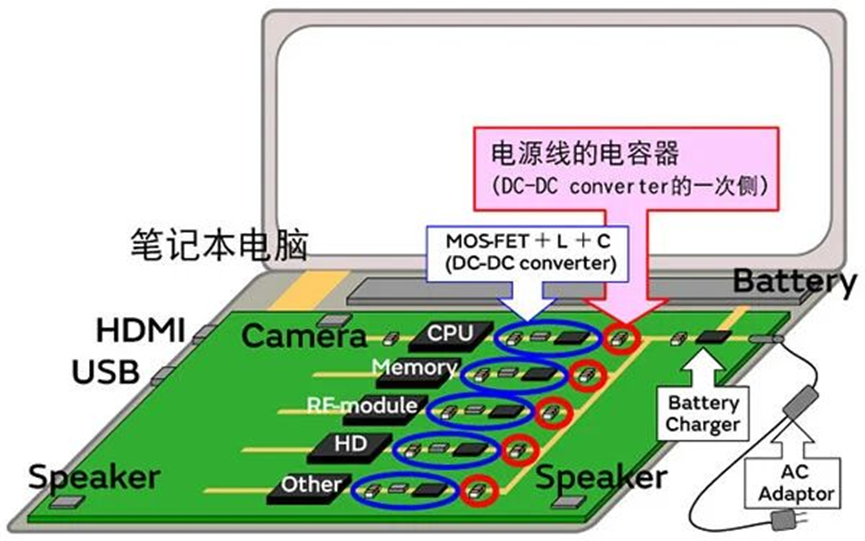
Simplified Diagram of Laptop Power Lines (Schematic)
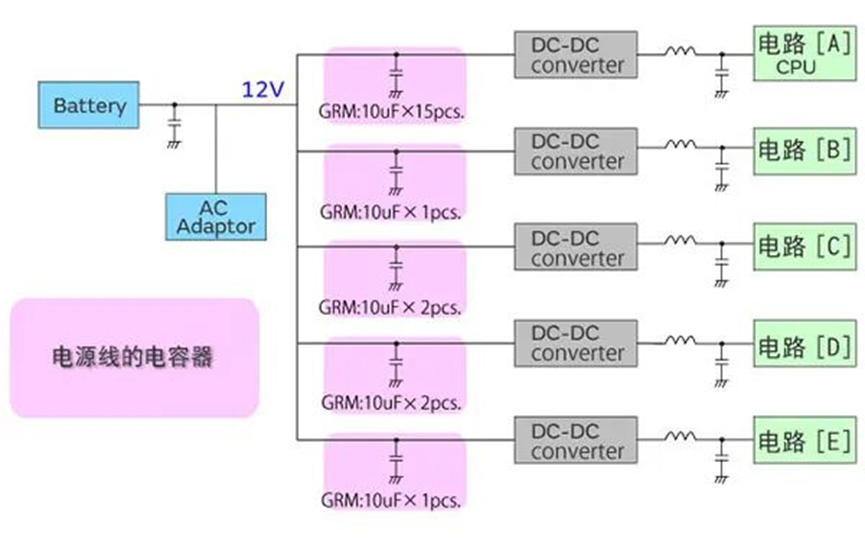
(Diagram description: Power input -> DC-DC Converter -> Power line with multiple capacitors -> Various loads like CPU, Camera, RF Module, LCD)
Generally, capacitors prone to generating "squealing" exhibit the following characteristics:
- Large Capacitor Size.
- Large Capacitance Value.
- High Line Voltage and Large Voltage (Current) Fluctuations.
- Multiple ceramic capacitors matching the above criteria are installed on the same line.
In summary, the reasons why capacitors on laptop power lines are prone to generating "squealing" are:
- Power line voltage is relatively high, typically 10-20V.
- Voltage fluctuations easily occur to supply power to various circuits like the CPU, camera, and RF modules.
- If the component size/capacitance is large, the dielectric expansion/contraction due to applied voltage also becomes larger.
Squealing Generation Mechanism
Why do multilayer ceramic capacitors generate "squealing"? The generation mechanism and Murata's evaluation methods for squealing are explained below.
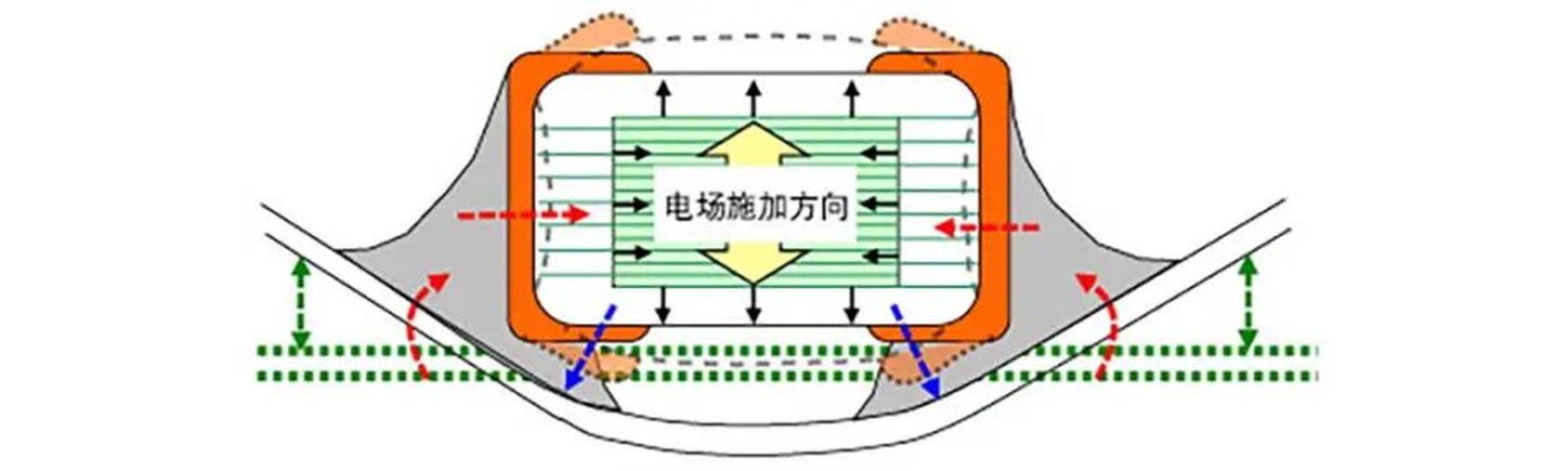
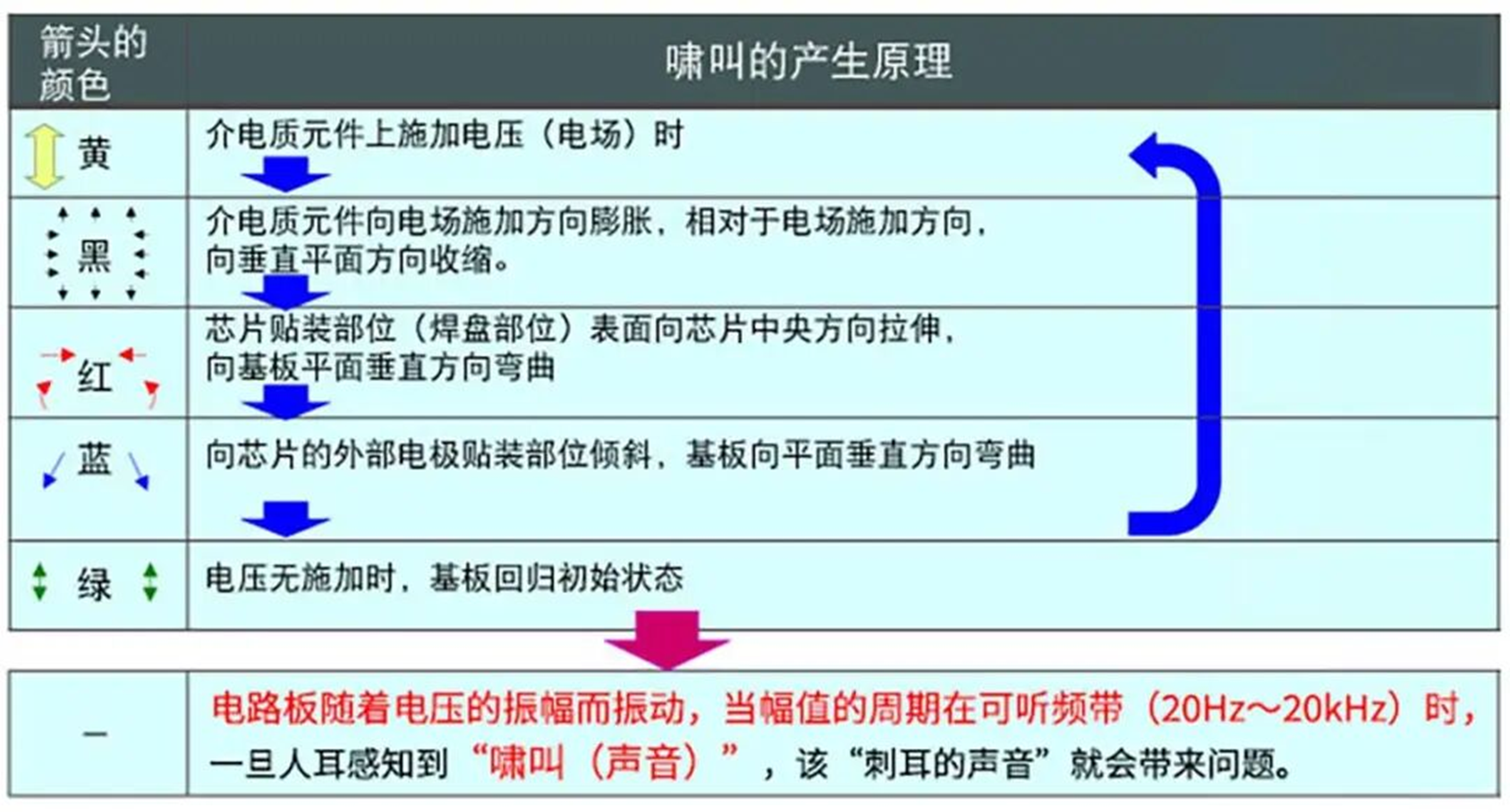
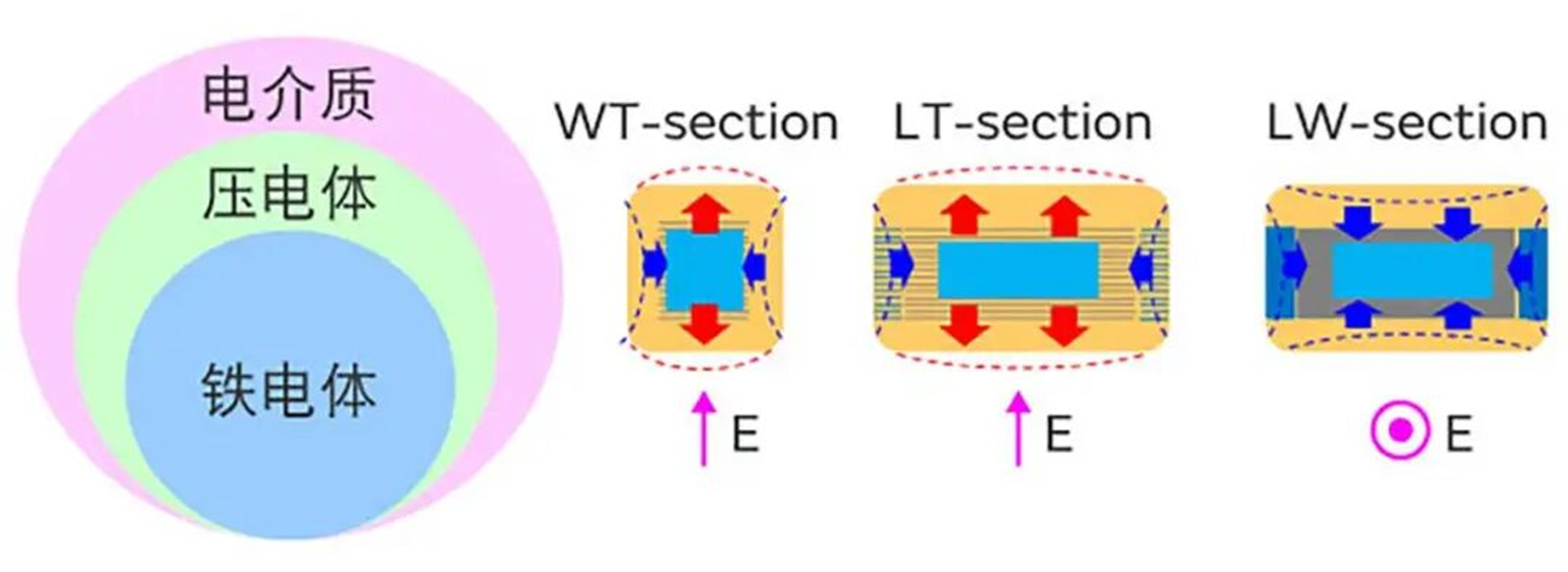
Mechanism of Squealing Generation
Ferroelectric materials used in multilayer ceramic capacitors possess piezoelectric properties. When an electric field is applied, distortion occurs. The expansion and contraction of the chip generate "squealing".
Effectiveness of Squealing Countermeasures
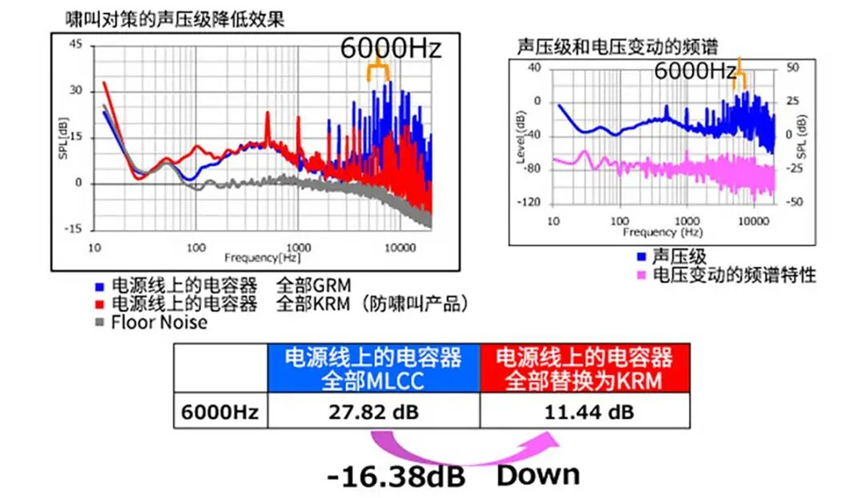
An example of the effectiveness of squealing countermeasures related to sleep mode/standby screen—operating modes prone to squealing and exhibiting high sound pressure levels in laptops.
Effectiveness on Power Line Capacitors
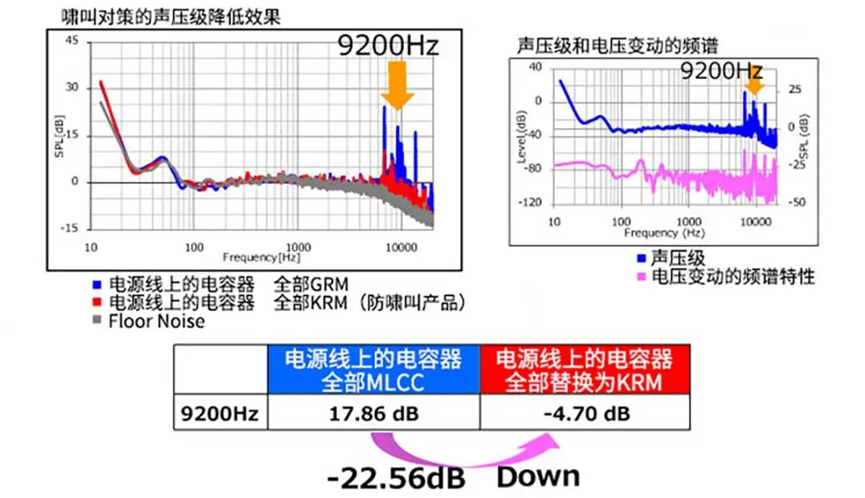
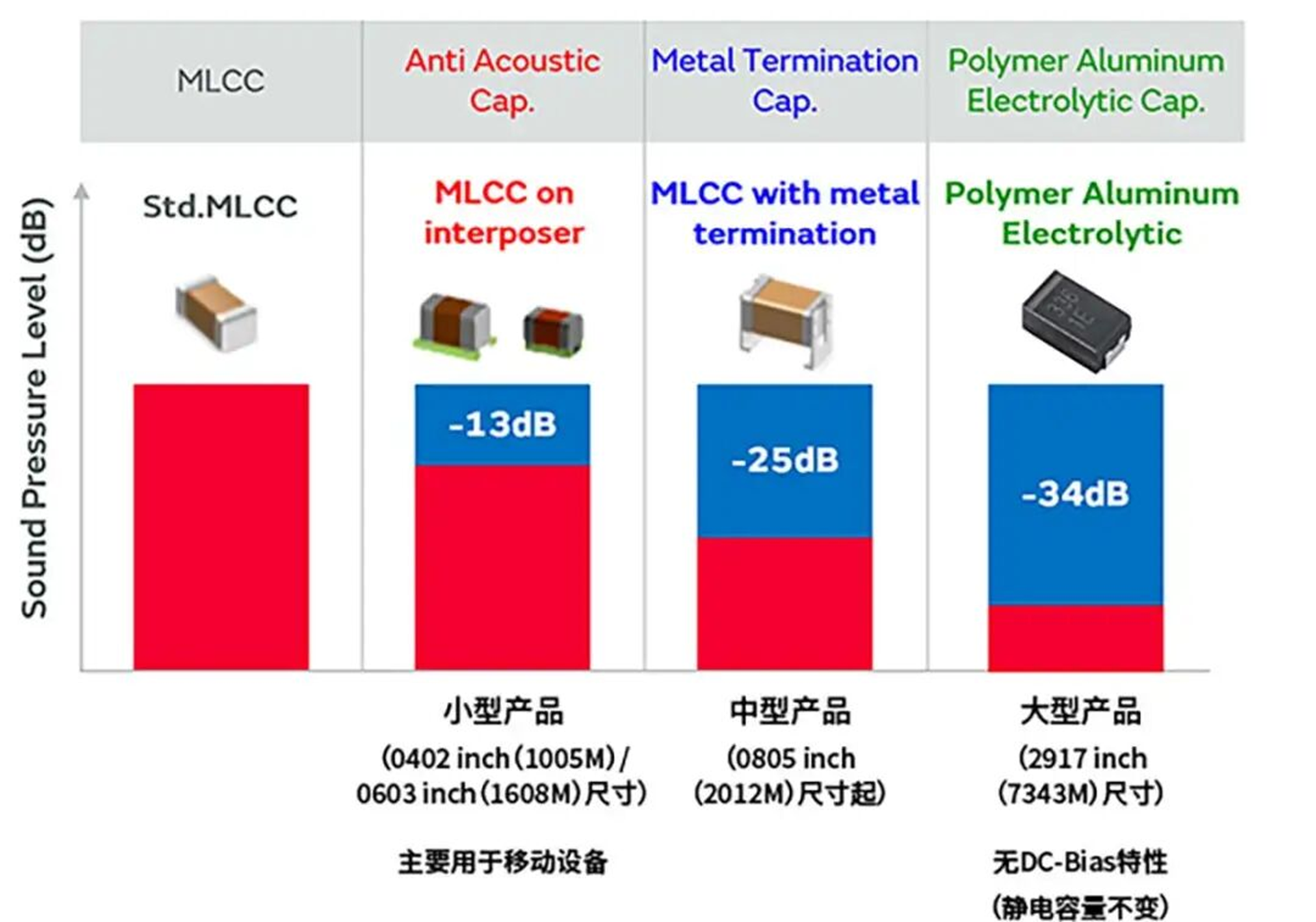
If squealing occurs when using ceramic capacitors on a power line, applying squealing countermeasures to the offending capacitors can reduce the sound pressure level. The effect comparison is shown above. Of course, the first step in addressing squealing issues is to evaluate the circuit's acoustic noise.
Evaluation of Squealing
The main methods for evaluating squealing are the following two:
- Sound Pressure Level Measurement
- Voltage Fluctuation Measurement
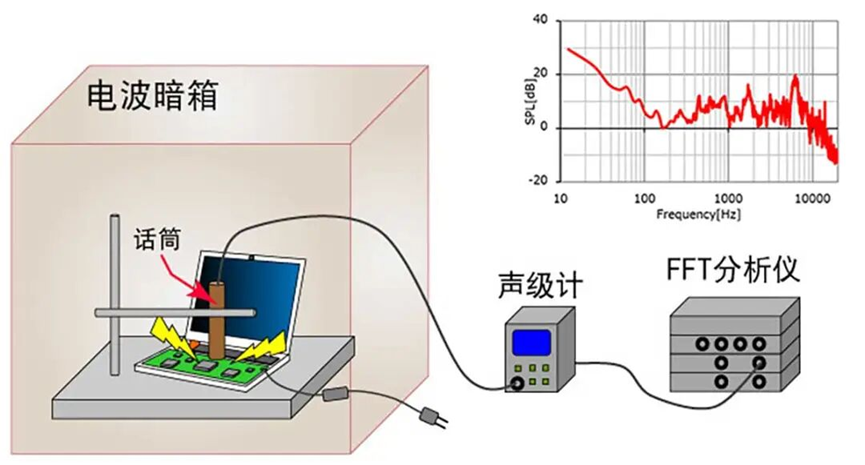
Since "sound" is the problem, "sound pressure level" is the primary measurement target. The device under test is operated inside an anechoic chamber, and the sound pressure level is measured using a microphone and a sound level meter. Additionally, for evaluation and countermeasure purposes, the frequency characteristics of the sound pressure level are confirmed using an FFT analyzer.
Sound Pressure Level Measurement
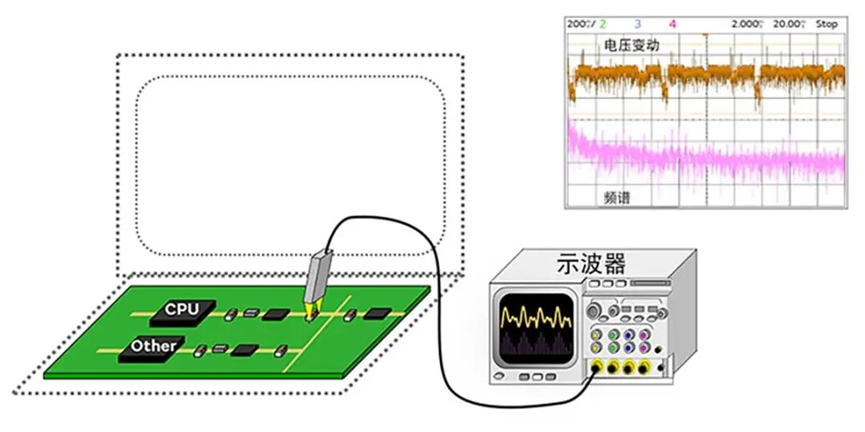
To identify the capacitor generating the squealing, we can also measure "voltage fluctuation." While the device under test is operating, we check whether a ripple voltage within the audible frequency range (20Hz to 20kHz) is applied to the capacitor.
Voltage Fluctuation Measurement
What is the relationship between sound pressure level and voltage fluctuation?
If the spectrum of the voltage fluctuation applied to a capacitor becomes high at the same frequency as the frequency characteristics of the sound pressure level (indicated by the red dashed box in the figure below), it can be determined that this capacitor is the cause of the squealing.
Relationship between Sound Pressure Level and Voltage Fluctuation
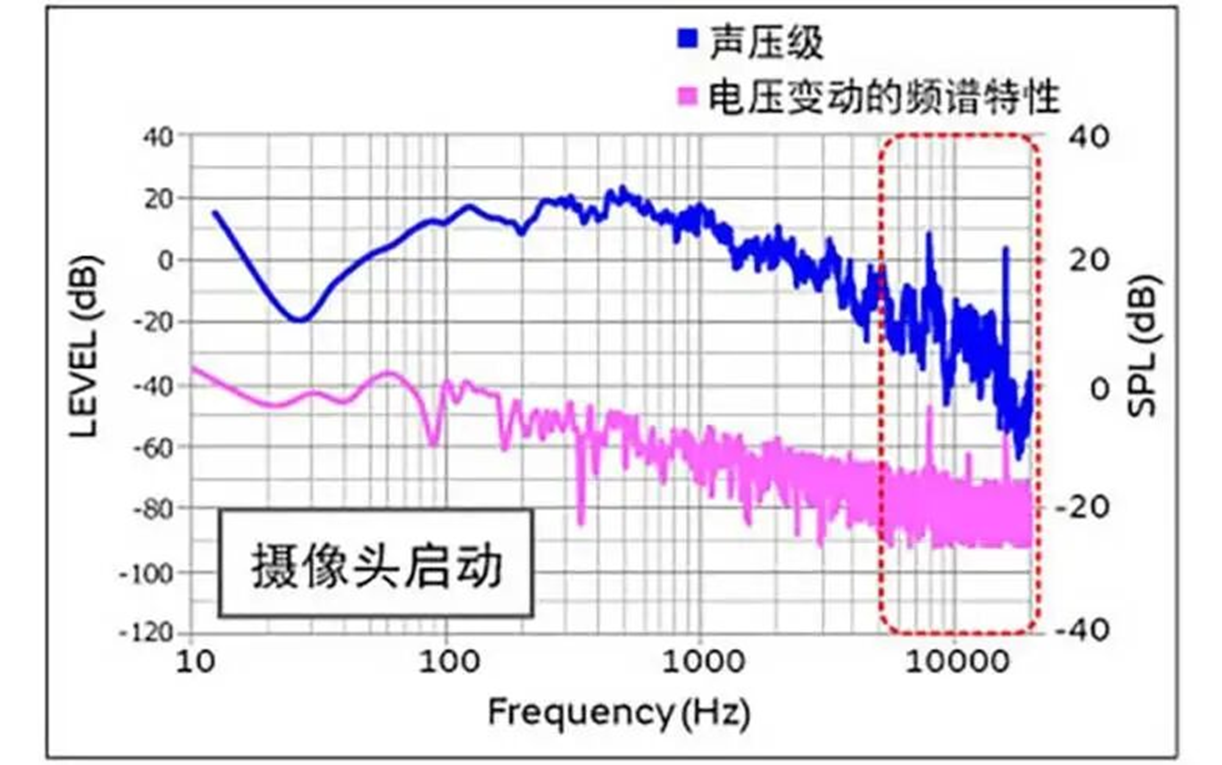
Case Study: Laptop Power Line
When the laptop's operating mode is changed to sleep mode or standby screen, the internal operations change, and consequently, the sound pressure level and voltage fluctuation also change. Since the sound pressure level differs depending on the operating mode, it is necessary to evaluate both the mode where squealing occurs and the modes where it is likely to occur separately.
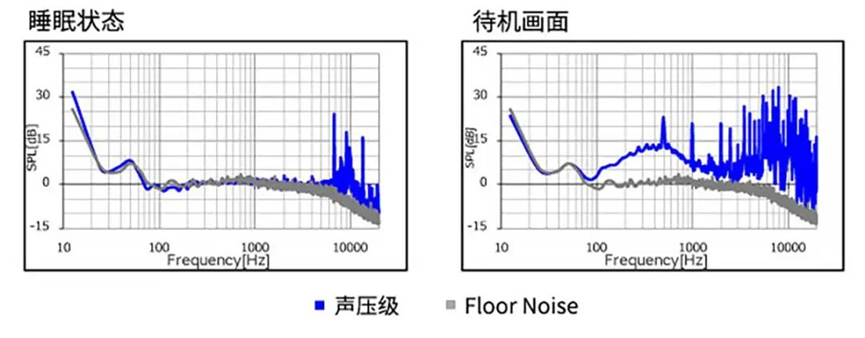
Sound Pressure Level Varies with Operating Mode
The figure below shows a simplified circuit diagram of the capacitors targeted for squealing countermeasures on a power line. The pink box indicates the capacitors on the power line that are prone to generating squealing and are the subjects of the countermeasures.
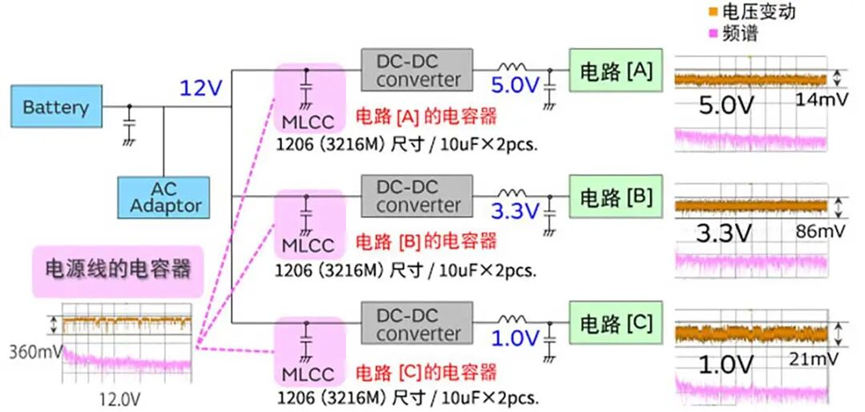
Capacitors Targeted for Squealing Countermeasures on Power Line (Simplified Circuit Diagram)
Before branching out to individual circuits via the DC-DC converter, these capacitors are on the same power line and experience nearly identical voltage fluctuations. Therefore, it is necessary to apply squealing countermeasures to all capacitors on this specific power line.
The countermeasure for power line squealing is not to replace some capacitors but to replace all capacitors on that line with anti-squealing products. This approach can further reduce the sound pressure level.
Following the circuit order [A → B → C], general-purpose capacitors are sequentially replaced with anti-squealing products.
The sound pressure level gradually decreases as the number of capacitors replaced with anti-squealing products increases.
Replacement Evaluation:
The capacitor products used in this evaluation are the following two Murata MLCCs:
- Before Countermeasure: General-purpose MLCC GRM31MR61E106KA01
- After Countermeasure: Anti-squealing product KRM31FR61E106KH01
Results for Sleep and Standby States:
Sleep Mode Replacement Evaluation Data
(Graph showing sound pressure level decreasing as more anti-squealing capacitors are installed)
Standby Screen Replacement Evaluation Data
(Graph showing sound pressure level decreasing as more anti-squealing capacitors are installed)
Introduction to Anti-Squealing Products
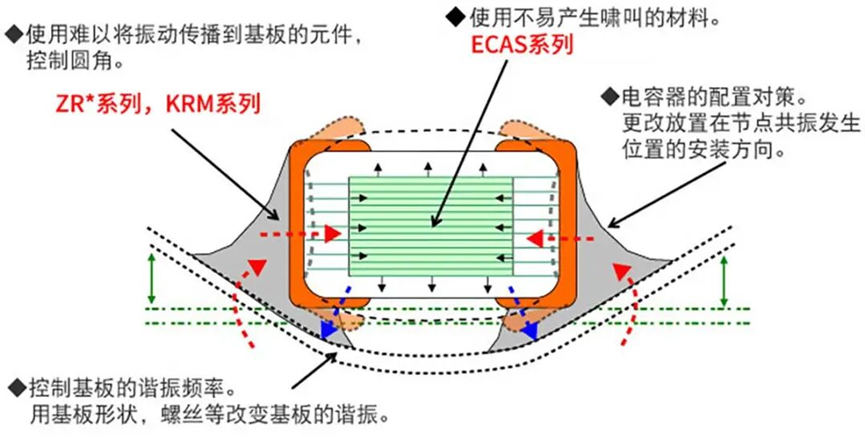
Understanding the causes of squealing and corresponding countermeasures is essential for correctly selecting anti-squealing products. At Murata, if a squealing problem arises due to the influence of ceramic capacitors, suggestions regarding the use of anti-squealing products and component placement are provided based on the cause, aiming to address and improve the squealing issue.
Causes and Countermeasures for Squealing
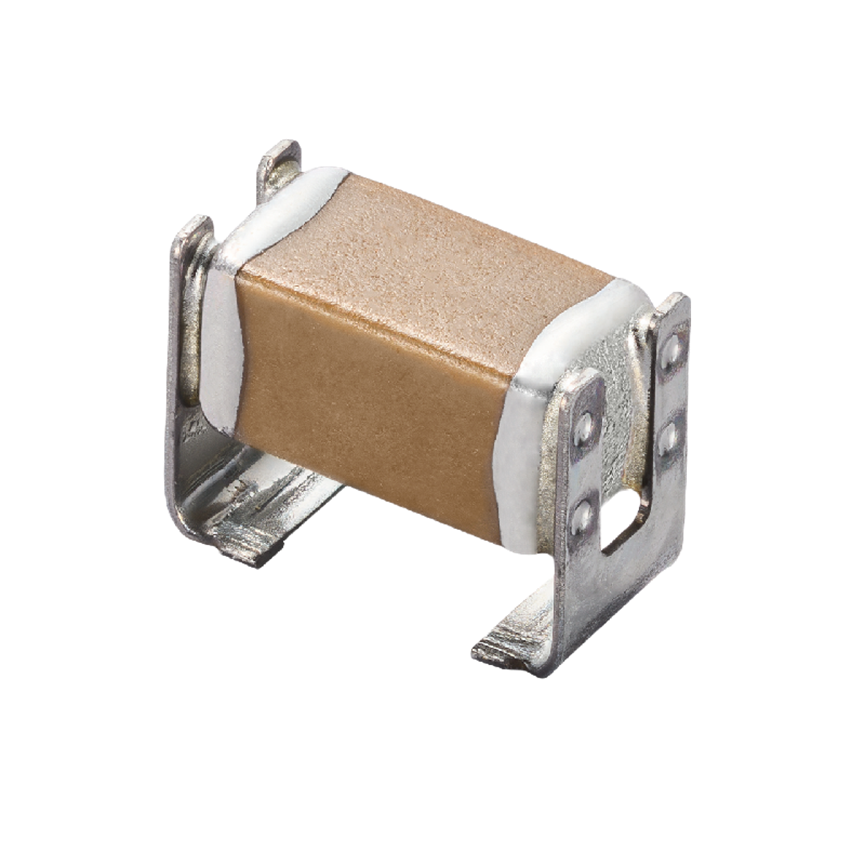
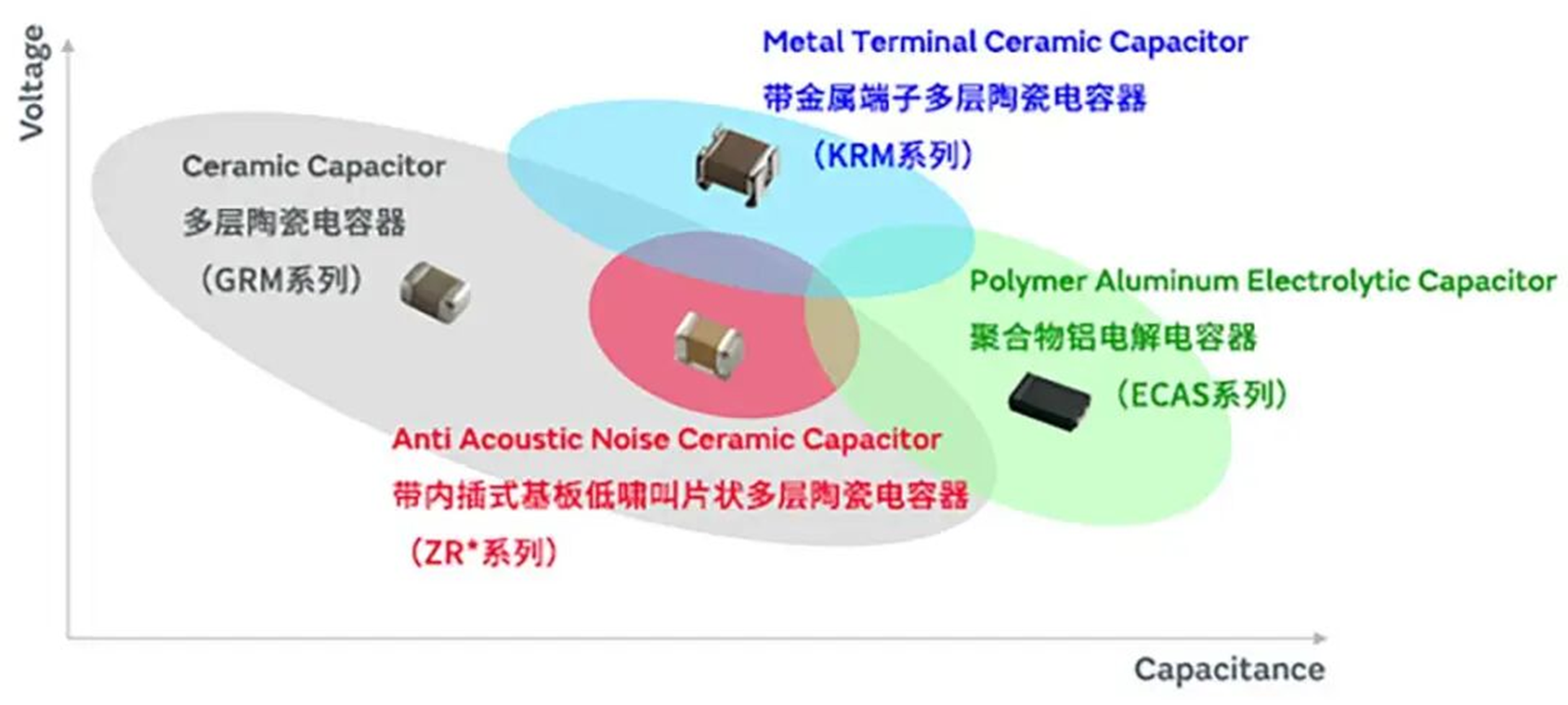
Countermeasure 1: MLCC with Metal Terminals
Control the fillet to make it difficult to transmit vibrations to the circuit board. Types with metal terminals can be used, such as Murata's KRM series of multilayer ceramic capacitors with metal terminals. By mounting the ceramic capacitor floating above the circuit board via terminal plates, vibration transmission to the board is suppressed.
Murata's KRM Series Multilayer Ceramic Capacitors with Metal Terminals
(Image of the KRM series capacitor)
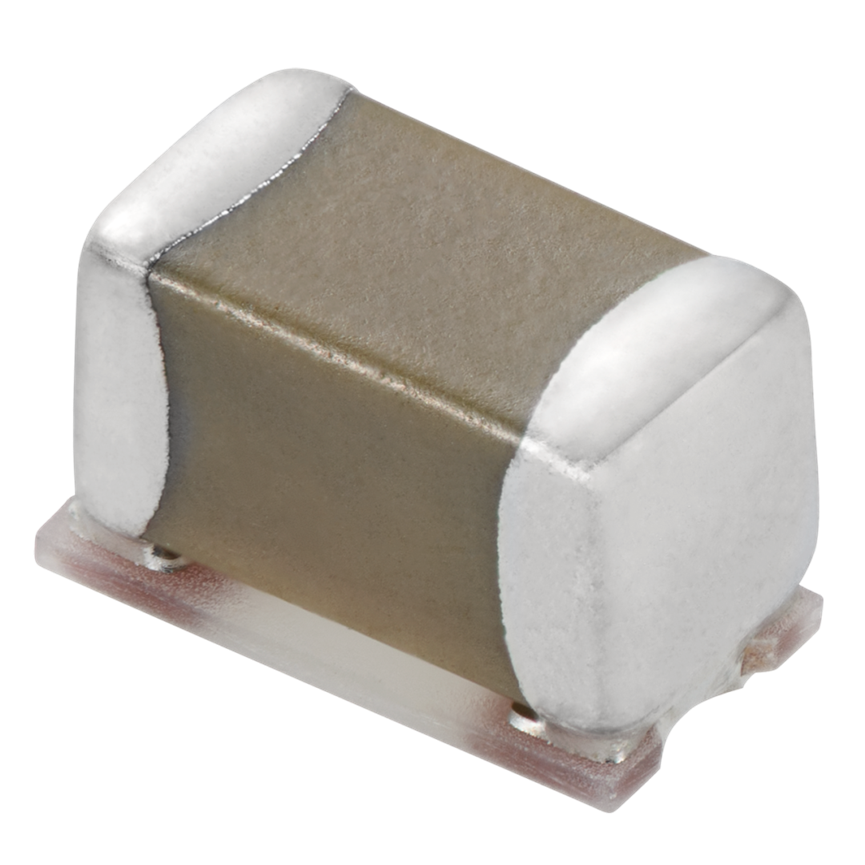
Countermeasure 2: Low Squealing MLCC with Interposer Board
Control the fillet to make it difficult to transmit vibrations to the circuit board. Alternatively, low-squealing chip multilayer ceramic capacitors with an interposer board can be used, such as Murata's ZR* series. This type suppresses the propagation of capacitor oscillation by mounting the ceramic capacitor on an interposer board.
Murata's ZR Series Low Squealing Chip Multilayer Ceramic Capacitors with Interposer Board*
(Image of the ZR series capacitor)*
Countermeasure 3: Using Materials Less Prone to Squealing
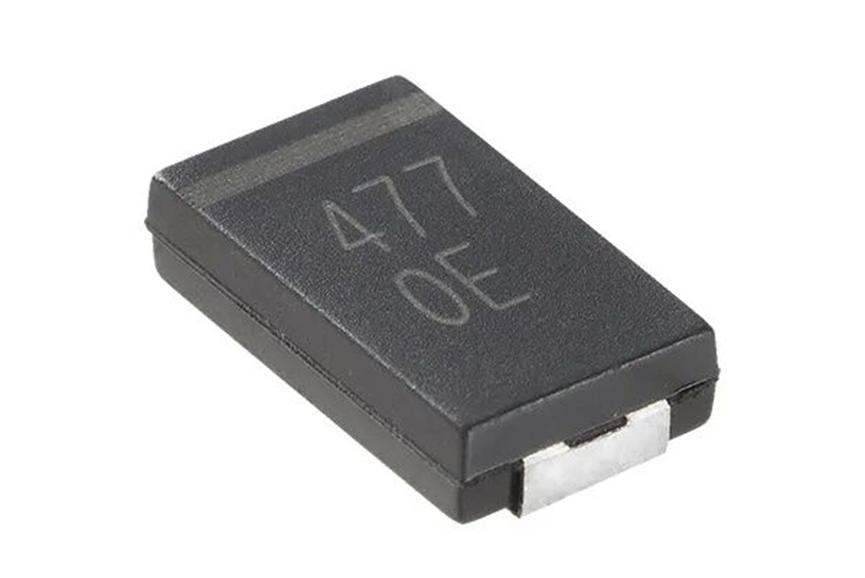
Use materials inherently less prone to generating squealing, such as Murata's ECAS series polymer aluminum electrolytic capacitors. The material and structure of polymer aluminum electrolytic capacitors differ from ceramic capacitors; therefore, this type does not generate distortion due to capacitance variation (piezoelectric effect).
ECAS Series Polymer Aluminum Electrolytic Capacitors
(Image of the ECAS series capacitor)
A comparison of the parameters and applications of the three countermeasure products mentioned above is shown in the table below:
Product Series | Key Feature | Mechanism | Typical Application |
KRM Series | MLCC with Metal Terminals | Metal terminals absorb/dampen vibration, preventing transmission to PCB. | Power lines, input/output circuits where vibration is a concern. |
ZR Series* | MLCC with Interposer Board | Interposer board isolates vibration from the main capacitor body. | Space-constrained applications requiring low noise. |
ECAS Series | Polymer Aluminum Electrolytic Capacitor | Non-piezoelectric material; no vibration generated by electric field. | Circuits where eliminating the vibration source itself is desired. |
Summary
Squealing Generation Mechanism
When voltage is applied to a capacitor, the circuit board vibrates according to the voltage amplitude. When the period of this amplitude falls within the audible frequency range (20Hz to 20kHz), the squealing generated by the capacitor becomes problematic as "audible noise."
Squealing Evaluation Methods
Since the problem is "sound," the sound pressure level was measured and evaluated, confirming the effect of replacement.
Determining whether squealing is caused by capacitors cannot rely solely on sound pressure level. To confirm the generation mechanism, it is necessary to measure and evaluate voltage fluctuation. (If necessary, measurement and evaluation of circuit board displacement are also required.)
Laptop Operating Modes Prone to Squealing
There are three operating modes in laptops where squealing is likely to occur:
(1) Sleep Mode (Buck Converter: PFM Mode);
(2) LCD Backlight (Boost Converter: PWM Dimming);
(3) Camera Mode / Heavy Load Mode (Intermittent Operation).
Capacitors Prone to Generating Squealing
Capacitors prone to generating squealing typically have several "characteristics":
(1) Large capacitor size;
(2) Large capacitance value;
(3) High line voltage and large voltage (current) fluctuations;
(4) Multiple ceramic capacitors meeting the above criteria installed on the same line.
In laptops, capacitors are used on power lines (primary side of DC-DC converters). Power line voltage is generally high, and they supply power to circuits with relatively high power consumption, making them susceptible to voltage fluctuations. Therefore, this section is prone to generating squealing.
This article discussed a replacement evaluation scheme for laptops. When the operating mode changes, the internal operations of the laptop change, and the sound pressure level, voltage fluctuation, and circuit board displacement also change. Therefore, it is necessary to evaluate each operating mode prone to squealing separately. When multiple ceramic capacitors are used on a power line (primary side of a DC-DC converter), applying squealing countermeasures not just to some capacitors on the line, but replacing all capacitors on that specific power line with anti-squealing products, can lead to a further reduction in the sound pressure level.
About E-Mantech
SHENZHEN E-MANTECH CO., LIMITED was established in 2014 with a registered capital of 10 million RMB.
Its predecessor was Shenzhen Hainengda Technology Development Co., Ltd., founded in 2005.
The company is committed to becoming the preferred trading platform for electronic components in the Chinese electronics industry.
Currently, it is a first level agent for Murata in Japan, an AVX agent, a Philips power agent, a KEC agent, a Prisemi agent for Xindao, a BPS agent for Jingfeng Mingyuan, a GPI agent for New Century,
a TELINK agent for Tailing, an SGX agent, and a WE smart agent. Our products cover fields such as communication, automotive, industrial control, medical, home appliances, lighting, power supply,
security, new energy, and consumer electronics; Our business covers regions such as Hong Kong, South China, East China, North China, Central China, and Southwest China.
Contact phone number: 0755-88352448 88352450
Official website: www.himantech.com
Official account: E-Mantech
QQ:800004227
Email: service@hi-mantech.com
Address: Room 1601, Block A, Coolpad Building, Intersection of Baoshen Road and Keyuan North Road, Xili Street, Nanshan District, Shenzhen
