
News
We will constantly surpass ourselves to create value for clients, strive for winning the long term trust from clients with better products and services!
Title: How is Murata Transforming the Expo into a "Testing Ground for the Future Society" with Cutting-Edge Technologies?
The "mysterious stone 'echorb'" provided by Murata for the Osaka-Kansai Expo features functions such as heartbeat detection and position detection. In areas not visible to visitors within the pavilion, Murata has deployed even more applications of advanced technologies, including micro-vibration detection technology using millimeter-wave radar sensors and load sensors, as well as reliable position detection technology using LF antennas.
Aiming to turn the Expo into a "testing ground for the future society," what cutting-edge technologies did Murata actually unveil at the 2025 Expo? Please join us in witnessing Murata's role in shaping the future society.

"3D Tactile Force Technology"
As a gold partner, Murata provided electronic component technology for the film pavilion "Better Co-Being" designed by Hiroyuki Miyata. The "mysterious stone 'echorb'" creates an illusion in the brain through vibration alone, making people feel as if they are being pulled.
How is this achieved?
The device uses the little-known "3D Tactile Force Technology." Natsuo Kohata, co-founder of Murata Group company MIRAISENS, which developed this technology, explains:

MIRAISENS was established in 2014 as a startup from AIST (National Institute of Advanced Industrial Science and Technology). The idea came after Kohata left Sony’s Kihara Research Institute and met Dr. Norio Nakamura, who was researching 3D Tactile Force Technology at AIST. A key feature of this technology is its ability to recreate the sensation of being pulled (force sensation), hardness/softness (pressure sensation), and touch-related sensations (tactile sensation). Recognizing its clear potential, Kohata co-founded MIRAISENS with Dr. Nakamura.
Why can it recreate such a wide variety of tactile and force sensations? The keyword is "illusion."
Kohata explains: "In 'optical illusions,' for example, a straight line can appear curved. In other words, an illusion is 'experiencing something impossible by leveraging the power of the brain.'" MIRAISENS' technology uses vibrations to create illusions in the brain, transcending physical limitations to generate new experiences.
Using illusions to create new experiences is not unfamiliar. For instance, in racing games, a standard game controller vibrates slightly to let users know road conditions. However, MIRAISENS uses vibrations to recreate a broader range of "sensory expressions," such as pulling, resistance, and roughness, providing a much more realistic experience.
Visitors can enjoy a "resonance experience" through the pavilion's artworks and the vibrations of the echorb.
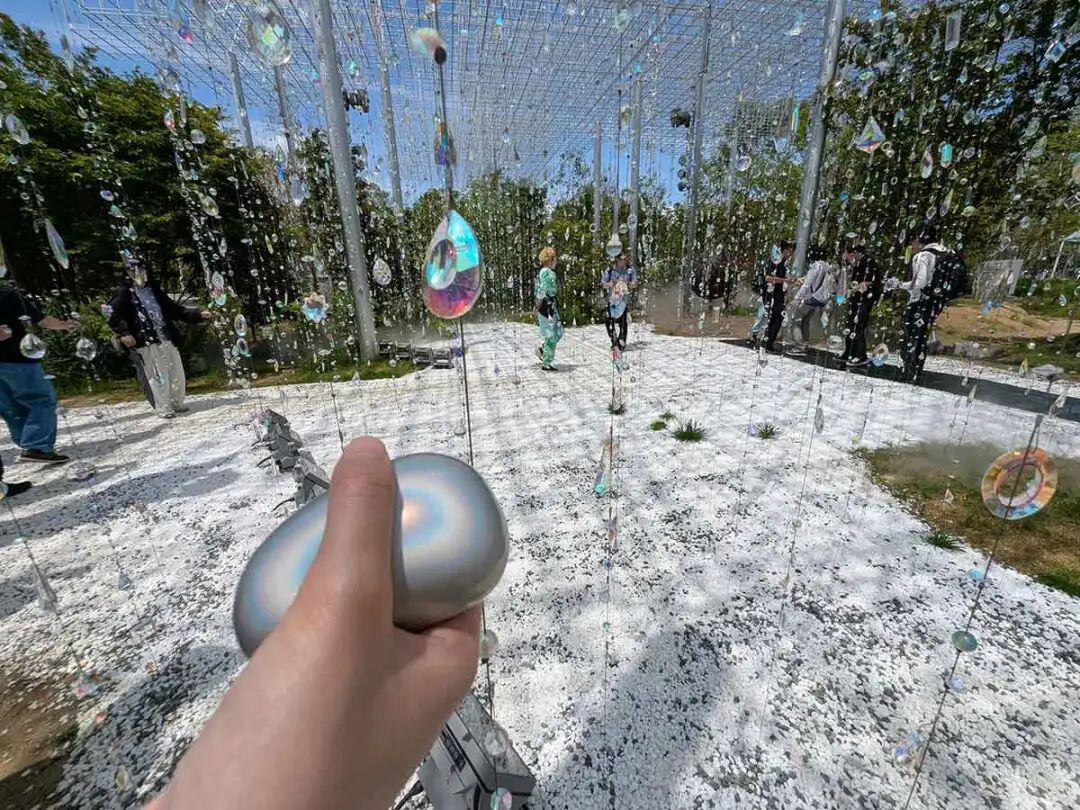
Exhibitors can enjoy a 'resonance experience' through the artworks and echorb vibrations in the exhibition hall
In 2019, Murata announced it was bringing MIRAISENS into the Group. At the time, MIRAISENS felt that having only a vibration algorithm made it difficult to take the next step. To reliably create illusions, they also needed to develop a component called an "actuator" capable of producing subtle vibrations. Thus, they decided to partner with Murata, a comprehensive electronic component manufacturer.
After MIRAISENS joined Murata and obtained the long-desired actuator, Kohata said: "I was very happy that MIRAISENS wasn't disbanded upon joining Murata. They also adjusted their internal mechanisms so we could maintain the speed of a startup. Now we have both the capital strength of a large company and the agility of a startup." This speed and technical capability were fully demonstrated in the development of the "mysterious stone 'echorb'" at the Osaka-Kansai Expo.

The technology contained in the incredible stone 'echorb'. LF antennas and actuators are manufactured by Murata. In addition, the "stone" is also equipped with many other electronic components from Murata.
The echorb incorporates technologies such as LF antennas and actuators manufactured by Murata, along with many other Murata electronic components.
Developing a portable 3D Tactile Force device, which normally takes two to three years, was accomplished in just six months for the echorb. Furthermore, MIRAISENS had previously focused on developing devices equipped with 3D Tactile Force Technology that only worked when connected to a PC. No portable device existed at the time, making the development path full of unknowns. Kenji Kagayama of MIRAISENS, responsible for the actuator that generates vibrations—the core of the technology—recalls:

Ultimately, MIRAISENS developed a proprietary actuator capable of two-way output, enabling complex illusions of being pulled forward, backward, left, right, and in all 360 degrees. It also excels in the precise vibration intensity and response speed required for tactile force

A proprietary actuator that vibrates in two axes was developed.
However, the actuator alone cannot create illusions for many visitors. To maximize its effect, improvements in software control technology and the hardware design of the echorb itself were necessary. The team members' "imagination" throughout development was remarkable. Kohata emphasized: "Until now, we have strived to meet manufacturers' specifications. But when we think about the future society, such 'specifications' don't exist. We need to actively think, 'What will the future society look like?' and deeply explore areas where specifications have not yet been defined."

The development team of the incredible stone: "Imagination" helps the development of "echorb"!
Millimeter-Wave Radar and Load Sensors
In fact, the "resonance" experience begins the moment visitors enter the pavilion. The chairs visitors sit on are equipped with millimeter-wave radar sensors and load sensors that can detect the heartbeat of the person sitting in them. In addition to 3D Tactile Force Technology, Murata has embedded technology to measure visitors' heartbeats inside the "mysterious stone 'echorb,'" using millimeter-wave radar sensors and load sensors. To detect the position of the echorb within the pavilion, Murata uses LF antennas.

The chairs at the entrance can actually sense heartbeats.

Information related to the visitor's detected heartbeat is shared with the stone in their hand, providing an experience of "feeling one's own heartbeat in the echorb."
Millimeter-wave radar sensors are currently used in applications such as automotive collision detection. These sensors have a detection accuracy of several tens of microns, precisely measuring distance to objects. Load sensors can measure minute fluctuations of one gram or less. Unlike mechanisms in standard scales, they are capable of sensing much smaller load changes. At the Osaka-Kansai Expo, combining millimeter-wave radar sensors and load sensors enabled more accurate heartbeat detection. This sensing technology, capable of detecting subtle body changes down to the millimeter and gram, supports the experiential value of the mysterious stone.

To design the desired experience, team members even built the chairs themselves and designed demonstration experiences—such as detecting minute body vibrations caused by breathing and displaying them as 3D waveforms. Deeper breathing produced larger waveforms, creating a visually engaging device.
The team also engaged in proposal activities far beyond the scope of a typical electronic component manufacturer. A typical example was considering the ideal design for the chair, potential durability issues when used by diverse people, and other factors. The Murata team internally confirmed these "areas typically handled by furniture-making specialists" while producing the chair.
Project lead Yasutake recalled: "We thoroughly investigated each issue, striving to find ideal solutions. For example, 'What value should we deliver to customers?' 'Can we ensure the chair's durability for use throughout the entire Expo period?' In addition to demonstrating Murata's 'commitment to delivery dates,' we also succeeded in leveraging our 'exquisite product manufacturing capabilities' without sacrificing quality." This responsiveness was highly praised, with other companies commenting, "Not only are they fast, but they also deliver high-quality results even under difficult circumstances."
Future Automotive Applications
Murata and related industries are considering applying many of the technologies demonstrated at the Expo to the automotive field. For example, millimeter-wave radar sensors could detect children accidentally left in vehicles. As driver monitoring applications, load sensors could be explored for drowsiness detection by monitoring heart rate fluctuations.
"Has a child been left in the car? Even if you try to use a camera, if the child is in a blind spot, the camera can't detect them. But with a millimeter-wave radar sensor, you can detect it immediately. Because it can detect heartbeats, it can also determine whether someone is in the car or just luggage." Additionally, load sensors are being considered for driver monitoring. Project lead Takateru Doi expressed confidence in these developments.

LF Antennas and Position Detection
The mysterious stone echorb also uses "LF antennas," typically employed in keyless entry systems for remotely operating car door locks. The system detects the echorb's position using magnetic fields generated by LF antennas buried underground. Accurately detecting the device's entry/exit within the magnetic field range allows the pavilion to provide experiences where the echorb vibrates in response when visitors approach specific artworks.

LF antennas buried underground detect the stone's position.
Murata's LF antennas are primarily supplied for vehicle keyless entry systems. In this case, Makoto Tochigi of the LF antenna team reflected: "The diverse values and perspectives of our team members led us to discover the new value of 'position detection via LF communication.' Our goal is to pursue this new value. We hope that succeeding in this installation at the Osaka-Kansai Expo will serve as a driving force to help solve various social issues in the future."
LF antennas played a crucial role inside the pavilion, but visitors cannot see them. This is because the receiving circuit for the LF antennas is installed inside the echorb, while the transmitting antennas are buried underground.

Takashi Kurokawa, responsible for the electrical circuit design, recalled: "On the other hand, the burial work had to keep pace with the pavilion's construction schedule, so the delivery deadline was extremely tight." In May 2023, it was officially decided to equip the echorb with LF antennas, leaving just over a year until product delivery in August 2024. Although the team had experience developing LF antenna electronic components, this was their first attempt at assembling them into a functional "finished product." Under the dual pressure of "having to develop the finished product independently with very little time left," the R&D team successfully resolved all issues through repeated trial and error and close collaboration.

Approximately 500 LF antennas needed to be buried 30 cm underground in the pavilion. To ensure communication performance, the antenna transmitters required waterproof housings. The team conducted field burial tests on Murata's land at the Yasu Plant (Yasu City, Shiga Prefecture), gradually gaining experience through continuous first-time experiments.
Notably, the LF antennas maintained stable position detection even when encapsulated in waterproof housings and buried underground—a significant advantage. Having been empirically tested for the first time at the Expo, LF antennas, leveraging their stable communication characteristics, are expected to be used in entertainment facilities.

Even when buried underground, stable communication is possible.
The Osaka-Kansai Expo was conceived as a "testing ground for the future society." Through the mysterious stone "echorb," Murata provided numerous previously unattainable technologies and solutions.
At the 1970 Japan World Exposition (Osaka Expo), "wireless phones (mobile phones)" and "electric vehicles" were showcased as futuristic dream technologies. Today, these products are commonplace.
At the 2025 Osaka-Kansai Expo, the technologies Murata embedded in the echorb may also become common in the near future.
What will the future look like? Let's read Murata's technical articles and imagine the future together.
About E-Mantech
SHENZHEN E-MANTECH CO., LIMITED was established in 2014 with a registered capital of 10 million RMB.
Its predecessor was Shenzhen Hainengda Technology Development Co., Ltd., founded in 2005.
The company is committed to becoming the preferred trading platform for electronic components in the Chinese electronics industry.
Currently, it is a first level agent for Murata in Japan, an AVX agent, a Philips power agent, a KEC agent, a Prisemi agent for Xindao, a BPS agent for Jingfeng Mingyuan, a GPI agent for New Century,
a TELINK agent for Tailing, an SGX agent, and a WE smart agent. Our products cover fields such as communication, automotive, industrial control, medical, home appliances, lighting, power supply,
security, new energy, and consumer electronics; Our business covers regions such as Hong Kong, South China, East China, North China, Central China, and Southwest China.
Contact phone number: 0755-88352448 88352450
Official website: www.himantech.com
Official account: E-Mantech
QQ:800004227
Email: service@hi-mantech.com
Address: Room 1601, Block A, Coolpad Building, Intersection of Baoshen Road and Keyuan North Road, Xili Street, Nanshan District, Shenzhen
